
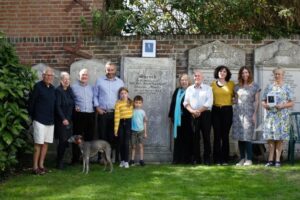
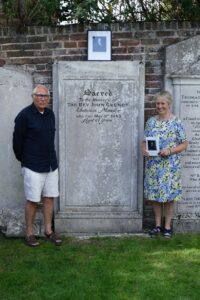
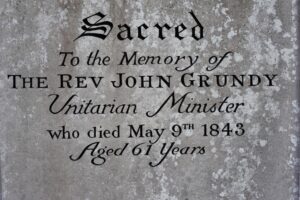
On Saturday 18 September, members of the Grundy family gathered in Bridport to hold an unveiling of the restored headstone inscription of their ancestor, the noted Unitarian Minister, Reverend John Grundy (1782-1843) who is buried in our chapel garden. The photo shows Karl Dixon the engraver and Angelica Kennard with three generations of great grandchildren of the Rev’d. John Grundy and his wife Anne Hancock. They are the offspring of their third son, the engineer and author, Francis Henry Grundy and his 2nd wife, Sophy Anna (Guiscard) Hayes.
Finding portraits of Rev’d John Grundy had sparked family members interest to find more about their ancestor who they learned was buried in Dorset. Nigel Hackett, a grandchild of the Reverend John Grundy, contacted our chapel Secretary, Angelica Kennard, who made the introduction to Karl Dixon of Dixon Memorials who agreed to take on the commission to restore the inscription, and Karl has expertly restored the inscription now visible to all in our chapel garden.
Rev’d. John Grundy received the majority of his education in Bristol with his maternal uncle, the noted Unitarian Minister, Dr John Prior Estlin. An early appointment was to High Pavement Chapel in Nottingham where he was ‘active as a controversialist and as an advocate of Unitarian views’. The chapel set up a successful mutual insurance association in 1807, the Provident Friendly Society, which came to an end only with the advent of National Insurance in 1948. This was followed by his appointment at Cross Street Chapel, Manchester where his lectures to a society of young men belonging to the congregation ‘created in the town such a religious ferment as it had never before witnessed.’ However, his views were not shared by all. Feelings were said to have ‘run so high that “Grundy and no devil for ever” was chalked on the walls of his meeting house’. The debate that resulted is known as the Manchester Socinian Controversy.
In 1835, failing health led to Rev’d. John Grundy’s retirement to Chideock, where the family hope he found better health given the fresh air of country and sea and peace in the company of fellow Unitarians in the years up to his passing in 1843. The family hopes to discover why Chideock became his last home and thanks Glenda Willis for kindly offering to help in this search.
The text comes from a monograph produced by Nigel Hackett which can be obtained at the Chapel if you want to find out more about this important Unitarian Minister.